The Cover of My New Book

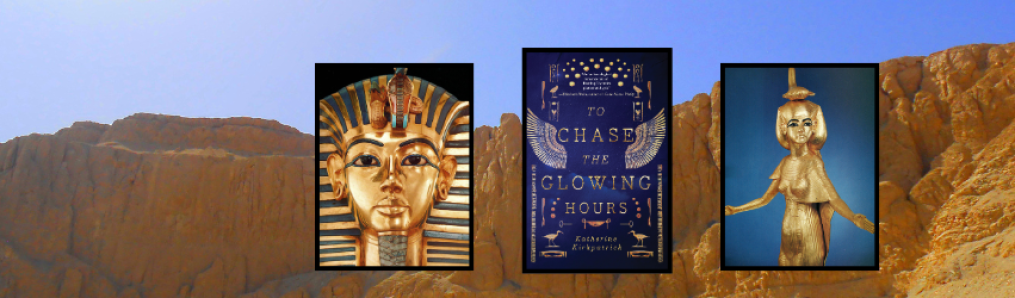
Dark blue was a favorite color in ancient Egypt. It is the color of the sky, home to the gods. Blue represents the cosmos and spirituality. It’s precious like lapis lazuli. I particularly like this color, so I am glad to see it featured on my new book cover.

Based on true-life characters and incidents, To Chase the Glowing Hours is a coming-of-age story about 21-year-old Lady Eve, who traveled in 1922 with her father, Lord Carnarvon, from her opulent home of Highclere Castle in the English countryside to the Valley of the Kings in Egypt. Her father’s hired archaeologist, Howard Carter, believed he’d found a royal tomb. A sealed doorway at the base of an underground stairway indicated that possibility. But of course, the phenomenal riches that Carter, Eve, and Carnarvon eventually uncovered would far surpass their expectations.

Gold was the color the ancients associated with royalty, divinity and immortality. King Tutankhamun’s tomb was filled with dazzling, golden objects, not least of them his solid gold sarcophagus. And since my novel To Chase the Glowing Hours (Regal House Publishing, September 2025) is about the Tutankhamun excavation, gold figures prominently on the cover. Gold also relates to the word “glowing” in the title.

The goddess Serket from Tutankhamun’s magnificent, gilded canopic shrine. Freepik.com

I wonder what Howard Carter would have thought of my book cover. As an exacting man who prided himself on his scholarship, he would have faulted its lack of accuracy. As attractive as the hieroglyphs are, they do not spell out an actual message. They are purely decorative.

Eve, however, would have enjoyed the cover. Her emotions and her senses guided her. Beholding Tutankhamun’s treasures as they emerged from the darkness was the greatest moment of Eve’s life. It wouldn’t have taken much to remind her of that experience—the warmth of a sunny day or the scent of perfume. The Egyptian theme of my book cover would have evoked a beautiful memory. 

For most people, enjoying ancient Egyptian culture is deeply connected to our senses. This is also true for me; however, reading books about Egyptian art has deepened my appreciation and understanding of it. Images that once puzzled me now resonate with clarity. Many Egyptian symbols relate to higher consciousness, immortality, eternity, and Oneness. These concepts are universal across various religions and hold personal significance for me.

Scarab design based on jewelry found in Tutankhamun’s tomb. Freepik.com

The pair of bird wings on the book cover resembles wings on scarabs. The scarab symbolizes rebirth. Wings lift the soul out of a discarnate body. The newly deceased pharaoh is often portrayed as a bird with a human head, as his soul is about to take flight. Deities are also depicted with wings; like birds, the gods and goddesses travel effortlessly throughout the cosmos. According to ancient Egyptian belief, we are soul travelers as well. There is a divine part in each of us that will ultimately express itself as starlight.

I hope you enjoy the deep blue and the elegant gold designs of the book cover. I especially hope you will enjoy reading To Chase the Glowing Hours. May the novel sweep you into the sensual world of King Tutankhamun’s treasures, ancient Egypt, and the worlds beyond.

The Art of Ink Painting

            Painting pictures is a nice change of pace for me. What I usually do is write very long books. My books involve a lot of research and require numerous rewrites. My forthcoming novel, To Chase the Glowing Hours (Regal House, Fall 2025), was in the making for twelve years before I received a contract to publish it. In contrast, I can usually create an ink painting in less than an hour. There’s a clear beginning, middle, and end to the process that feels very satisfying to me.

            I love the spontaneity of ink painting. I love the aesthetic of the art form. I love its simplicity. The goal of Chinese and Japanese ink painting is to capture the essence of something in a few bold strokes. You try to tap into the energy of your subject matter. You add only the details you want to be there.

“Red Crowned Crane” by Katherine Kirkpatrick.

            I’ve enjoyed making art ever since I was in high school, though I’ve let years lapse in which I did no drawing or painting. Twenty-three years ago, soon after my twins were born, I decided I wanted to learn Chinese ink painting. My family’s house has a view of a lake, and seeing the mist over that lake on cold winter mornings motivated me to paint the scene.

            I tried using regular watercolors on sturdy watercolor paper. To convey the mood of the mist and water, I diluted the paint. But I could not stop myself from outlining. My paintings looked tight and rigid. I remembered the softness of Chinese paintings on silk, the dark mountains emerging from clouds. How did those ancient Chinese artists create their atmospheric effects? My urge to learn their techniques was very strong.

            Through a Chinese community center, I found a teacher. His name was Long Gao and he taught out of his home. He’d been a professor of art in Beijing before moving to the U.S. His wife taught piano. Out of their many art and music students, most of them children, I was the only one who did not speak Chinese.

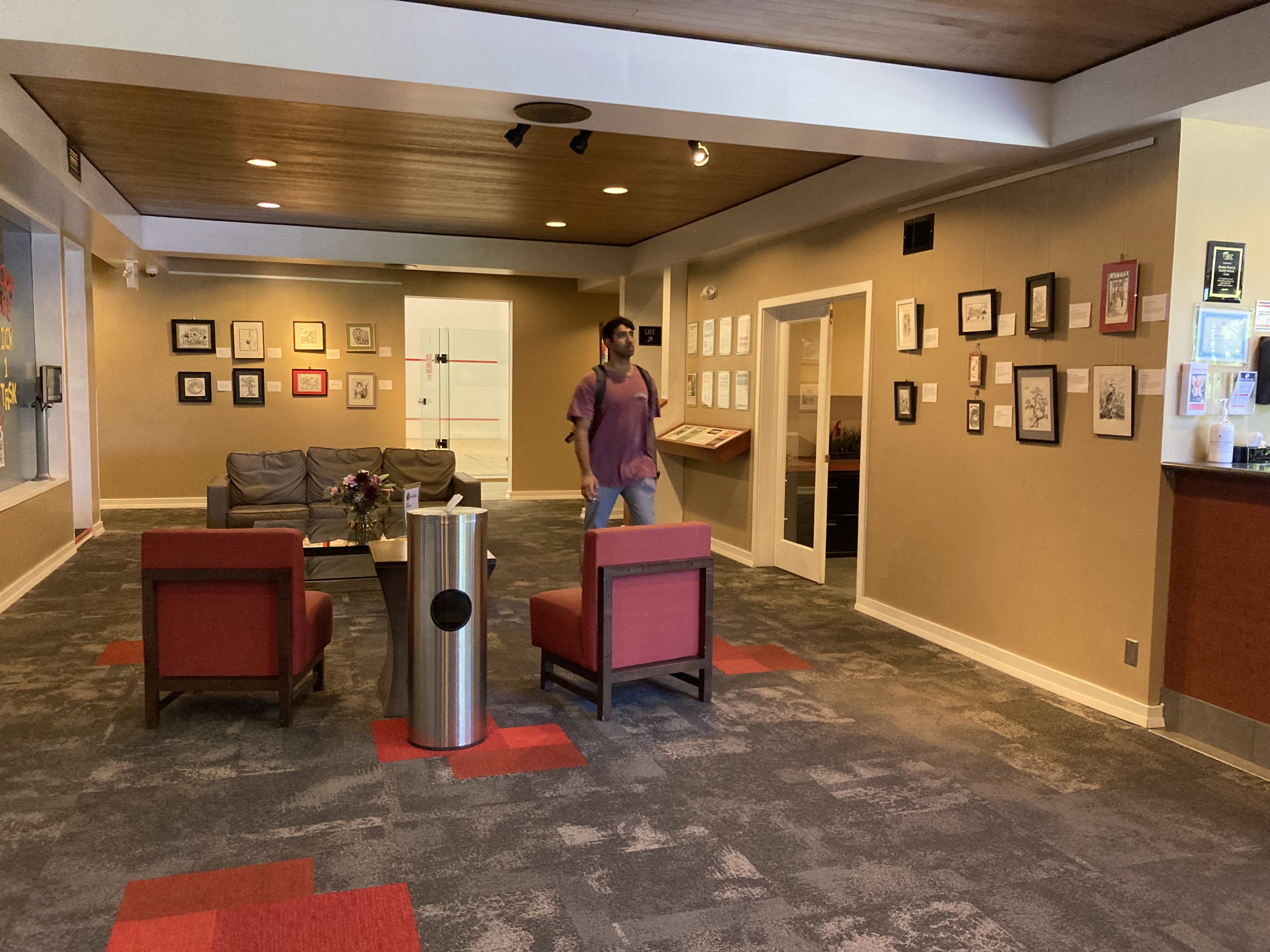
My art show in an athletic club.

            A stay-at-home mother, I had babysitting help twice a week for stretches of four hours. Once a week for several years, I had a private lesson from Long Gao. He is a phenomenal artist and a wonderful teacher. Ink painting is only one of his many mediums. He is well known as an oil painter and as a sculptor.

            Teacher Gao sold me a large sheep-hair brush, and two other brushes that were a combination of horse-hair, wolf-hair, and badger-hair. He showed me how to soak my brushes in water, and how to flex them so they’d slowly absorb the black ink. I learned that if I could load the ink on my brush in a certain way, each stroke I made on the rice paper presented several tonal values.

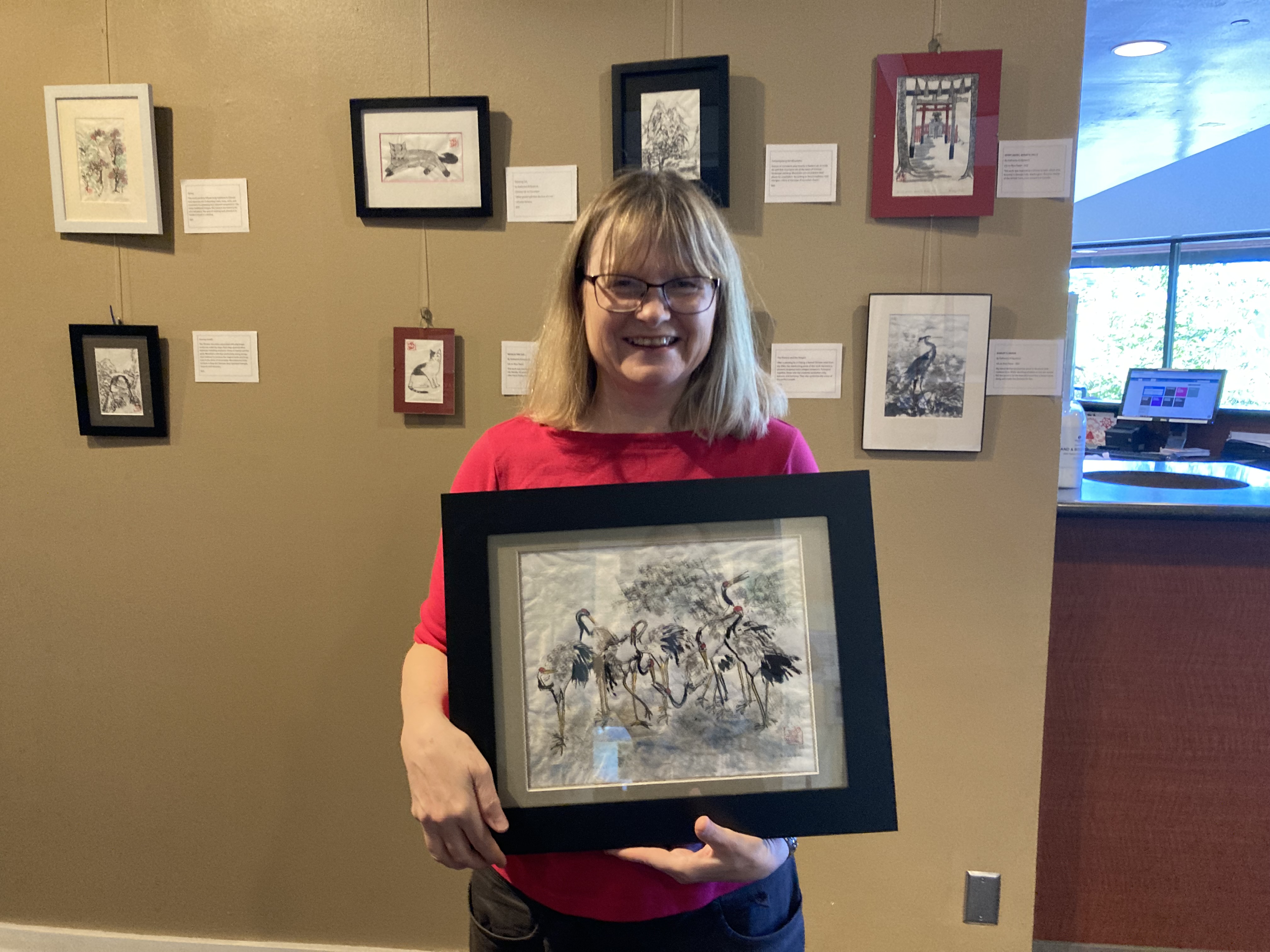
At my art show in the athletic club, holding a painting of cranes, “The Social Hour.”

            One of the first subjects I learned to paint was bamboo. We began with the stalk. “Paint in the direction that the bamboo is growing,” Teacher Gao said. He showed me how to push the brush forward, pausing between segments. “Paint with the energy of the heart going out through your arm, into your hand, and into the brush,” he taught me. Over time, I realized I was learning a spiritual practice akin to meditation, and that it was very important to paint from a state of inner quiet.

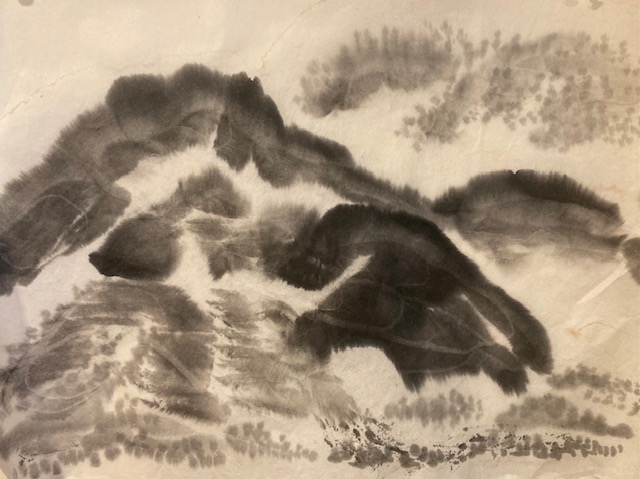
            One week, Teacher Gao placed a three-sided rock on his art table to serve as inspiration for painting mountains. Numerous mountains could be painted without dipping the brush into more ink. When the brush became drier, its ink came out lighter on the page. The lighter ink worked well for painting the suggestion of distant peaks. To create clouds or mist, I simply needed to leave white space between the forms of my mountains and peaks. This was the answer to the question that had started me on my journey of ink painting.

One of my first ink paintings.

            Teacher Gao carved my beautiful chops (printing stamps). He created an image of twin birds in honor of me being the mother of twins. The other image, designed with Archaic Chinese characters, is a Buddhist name I was given many years ago by a Soto Zen master in New York: Ro-ki (Japanese) or Ro-chi (Chinese), meaning “bright life force.”

            I was very lucky to have studied traditional ink painting with Teacher Gao, and I think of him every time I “sign” my paintings in red with the chops that he made.

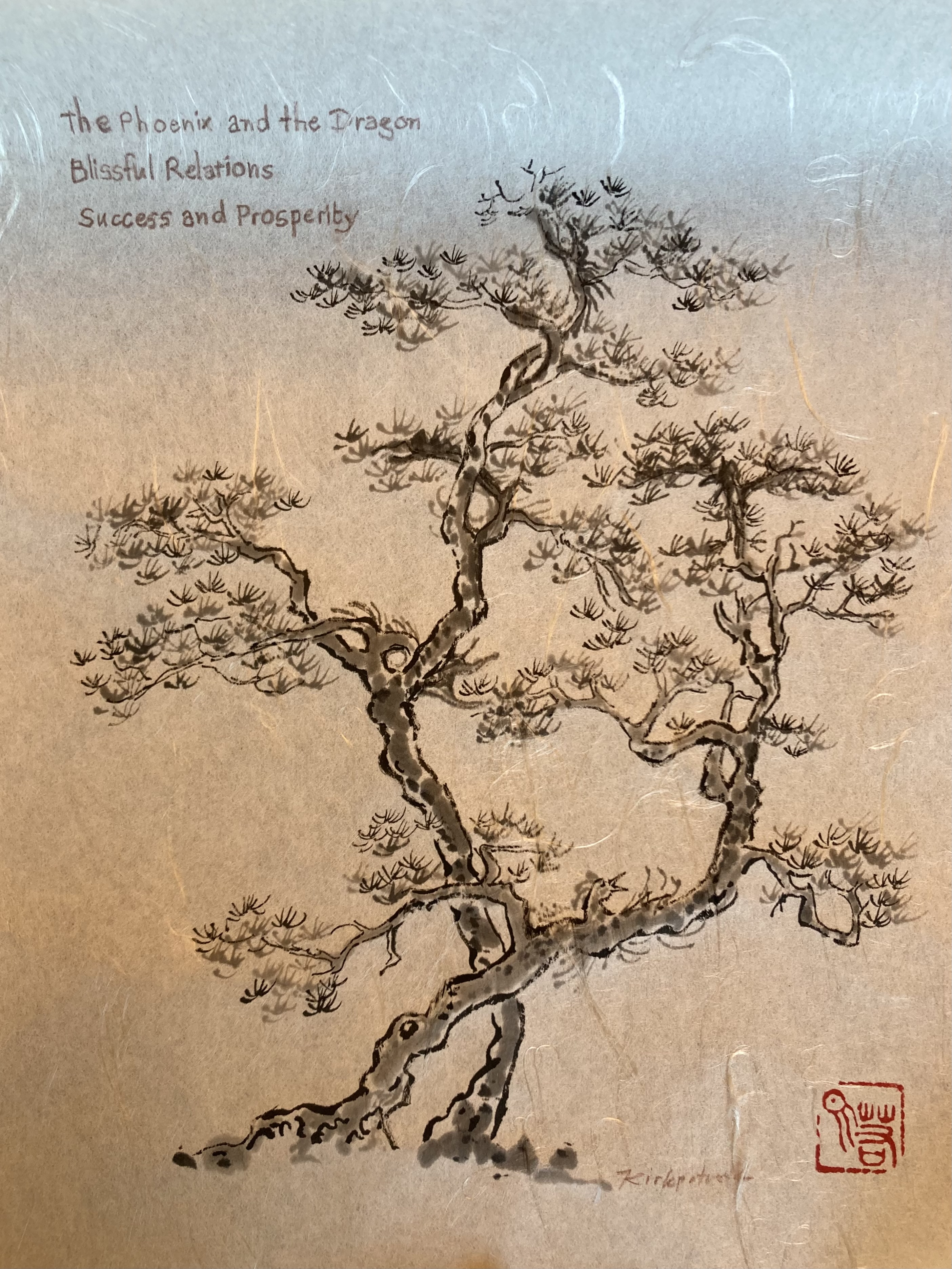
“The Phoenix and the Dragon” by Katherine Kirkpatrick after Li Cheng (919-967 A.D.)