Katherine Kirkpatrick’s Historical Novel Society Interview

INTERVIEW BY KAREN DRURY for The Historical Novel Society

Katherine Kirkpatrick is the author of ten books, both fiction and nonfiction. When not flying over the Valley of the Kings in a hot air balloon or exploring the secret cabinets of Highclere Castle, she can be found at her computer in Seattle, Washington. Check out Katherine’s YouTube videos on the To Chase the Glowing Hours playlist.

How would you describe this book and its themes in a couple of sentences? 

To Chase the Glowing Hours features the real-life residents of Highclere Castle, the manor made famous in the Downton Abbey television series and films. Lady Eve, the 21-year-old daughter of the Earl of Carnarvon, travels from her opulent home in the English countryside to the Valley of the Kings in Egypt. There, she hopes to realize her father’s dream of finding an intact royal tomb, that of King Tutankhamun. Amidst the excitement of her adventure, Eve finds herself drawn to the brilliant yet temperamental archaeologist Howard Carter. Set against the alluring and glamorous backdrops of Egypt and England in the 1920s, the novel explores themes of love, grief, loss, privilege, and self-discovery.

What inspired you to write this novel?

My fascination with ancient Egypt began as a young child. In 1977, my parents took my family to see the Tutankhamun exhibition at the Metropolitan Museum of Art (MMA) in New York. I stood before Tut’s gold mask, mesmerized. Years later, as I wrote To Chase the Glowing Hours and envisioned Lady Eve entering the tomb, I tried to convey the same sense of wonder I’d felt at the Metropolitan Museum.

My beloved brother, the late author and filmmaker Sidney Kirkpatrick (see SidneyKirkpatrick.com), introduced me to the subject of Lady Eve and suggested I write her story. He learned of Eve when he was interviewing Thomas Hoving, a former director of the Metropolitan Museum of Art. Hoving’s book Tutankhamun: The Untold Story contains an intriguing footnote that became the basis for my novel. Hoving found Lady Eve’s letters to Howard Carter in the Metropolitan’s archives and remarked on their gushing tone.
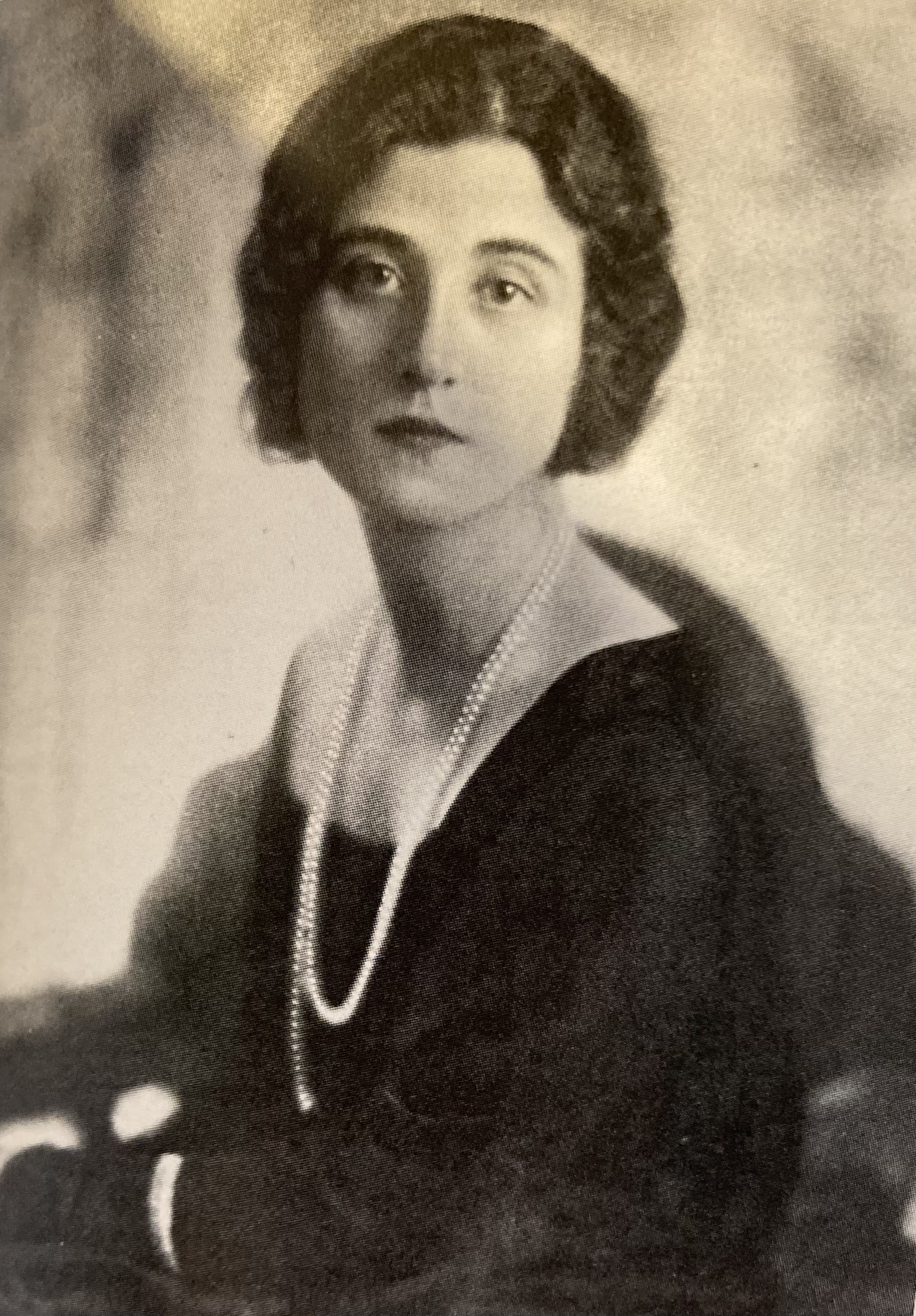
Lady Evelyn Herbert, daughter of the Earl of Carnarvon of Highclere Castle

Would you consider writing the Egyptian side of the story? 

Great idea! Someone Egyptian will have to do it. I hope archaeologist Dr. Zahi Hawass will write a novel about the excavation (he’s writing novels now, you know). Ahmed Gerigar, the chief foreman for the Tutankhamun excavation, would make a good protagonist. Gerigar was an archaeologist in his own right. He didn’t have a university degree or professional affiliation. But neither did Howard Carter (nor Lord Carnarvon, for that matter). But unlike the British men on the dig, Gerigar is never referred to as an archaeologist or Egyptologist or given much credit.

What is your research process? 

I do enough book and archival research to get myself started, then continue to research while drafting. Whenever possible, I visit my book’s settings. For Glowing Hours, I toured Eve’s home, Highclere Castle, twice. That was relatively easy; my late mother-in-law was British, and I was already in a pattern of visiting England every two or three years. Journeying to Egypt was a far bolder adventure to undertake. I left my husband and two young children at home in Seattle, and joined my sister, Jennifer Kirkpatrick, my brother-in-law, Eric Zicht, and my niece, Alice, for an expedition. We stayed in the Luxor Winter Palace Hotel, Lady Eve’s hotel. We visited Howard Carter’s house. We explored Tutankhamun’s tomb, of course. We ferried down the Nile and flew over the Valley of the Kings in a hot air balloon.
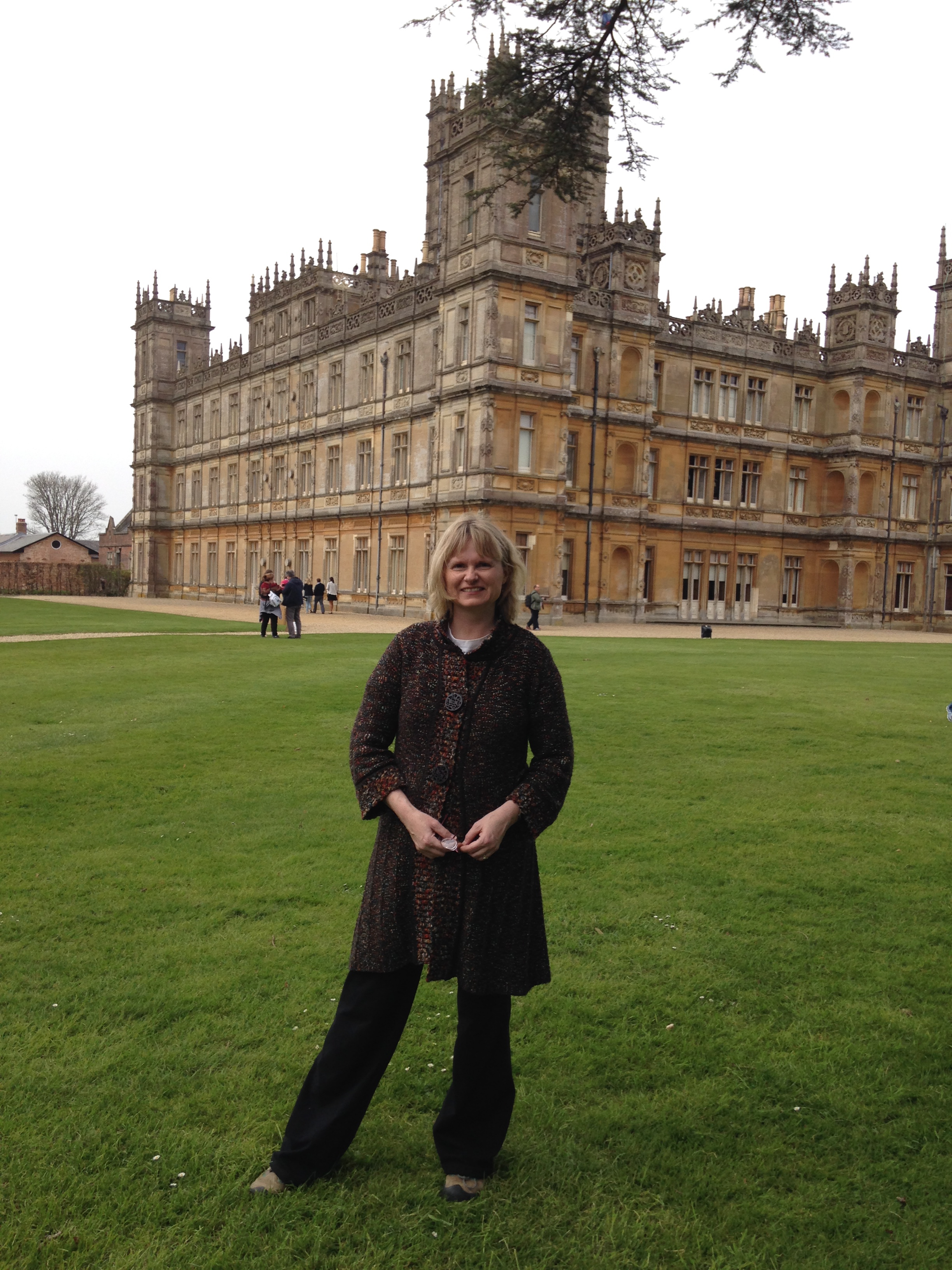
The author at Highclere Castle.

What research did you leave out for this book? 

Eve’s lady’s maid, Marcelle, accompanied her to Egypt on some of her trips. The Egypt scenes were better without her.

What’s hardest for you to write in fiction – real people in history, or fictional characters living in the period? 

Real people.  If you make up too many details, you open yourself up to criticism by readers. At the same time, if you don’t make up details, characterization falls flat. History comes to life through a character’s feelings, thoughts, and opinions.

The colonial aspects of the period might jar some readers. How do you balance the authenticity of the book and its era with modern sensibilities?

The allotment of the treasures is a crucial element of the plot. The discovery of the tomb coincided with the Egyptian nationalist movement toward total independence from Britain. Before the 1920s, foreign excavators claimed a considerable share of the findings. The Egyptian government’s insistence that the Tutankhamun artifacts remain in Egypt became the basis for a new, essential, equitable policy.

Early in the book, Eve, like her father, imagines how nice it would be to see statues from the tomb framing a great fireplace at Highclere Castle. Later in the book, she adopts a more modern point of view that the treasures ought to remain in Egypt. That change of consciousness occurs gradually over many chapters. If the character of Lady Eve had not evolved in that way, she’d come across as highly unsympathetic.

What is your occupational background, and how does that shape your writing?

For a decade after college, I worked in New York City in editorial and rights jobs at E. P. Dutton, Henry Holt, and Macmillan, and as a freelance writer and editor for educational publishers. Though I never rose high in the ranks, I learned a lot about the book business and gained contacts. I sent my first young adult novel to the Delacorte Press, to a former boss of mine; she published it, and numerous other books.

After 2000, on the West Coast, I stayed at home to care for younger and older family members. Frequent trips to libraries gave me a good excuse to see what new titles were being published. Reading lots of books aloud came with many benefits, both for my children and for me. While caretaking, I also learned to manage my time efficiently.
What’s your next project?

I’m returning to some children’s book projects for the first time in a decade.

What’s your best writing advice?                                            

Learn about story structure before you get too deeply into a draft. Scott Driscoll, professor of fiction writing at the University of Washington’s Professional and Continuing Education department, taught me about structure. He uses Story by Robert McKee in his classes. My other advice is to make book trailers to generate excitement for your title. To see photos of the real Lady Eve, visit the “To Chase the Glowing Hours” playlist on my YouTube channel, Katherine Kirkpatrick Sketches_and_Explorations.

What is the last great historical fiction novel you read?

Horse by Geraldine Brooks. May we all aspire to writing such beautiful prose.

Thanks for the interview!
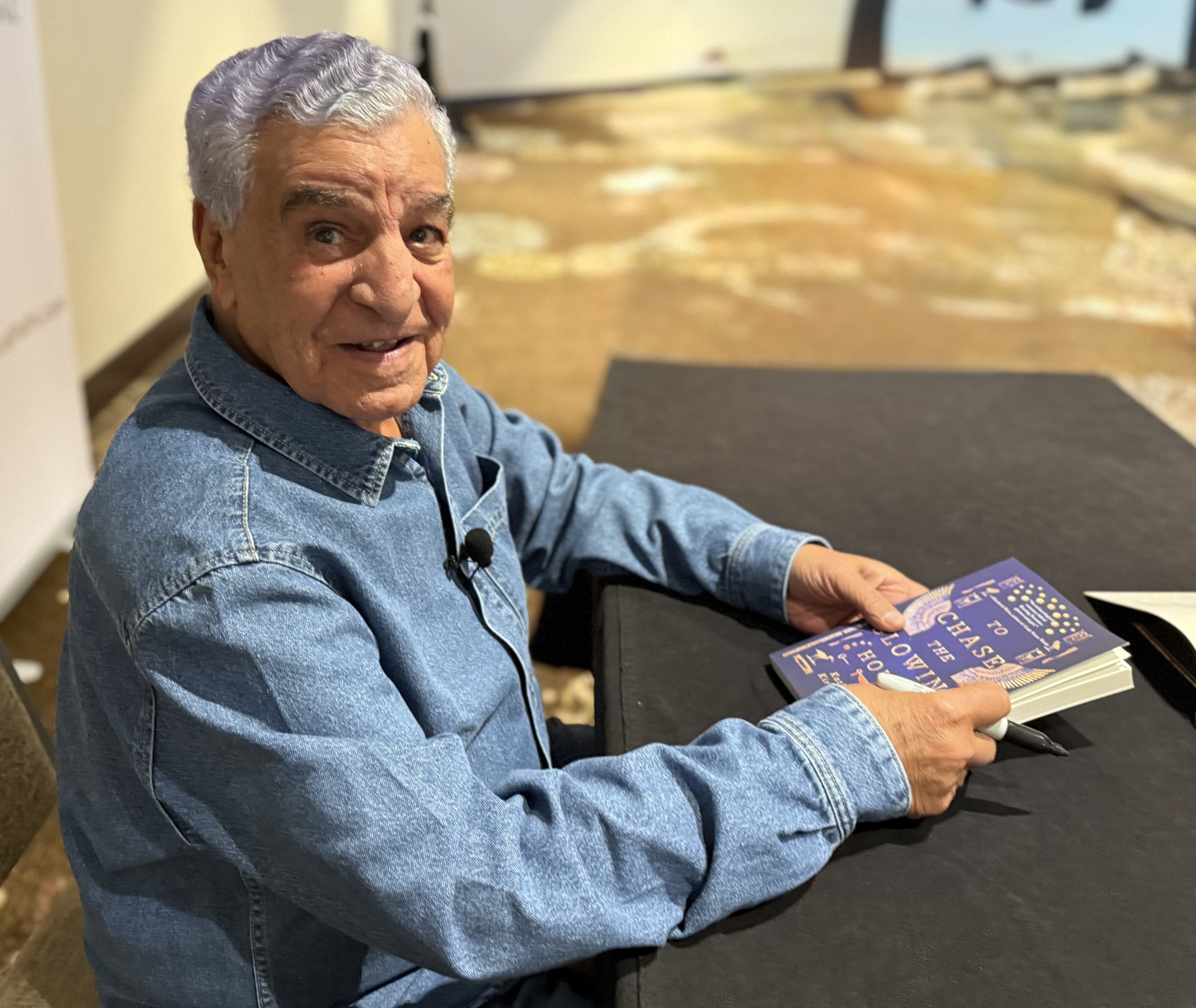
Dr. Zahi Hawass, Egyptian archaeologist.

Katherine Kirkpatrick and Dr. Zahi Hawass

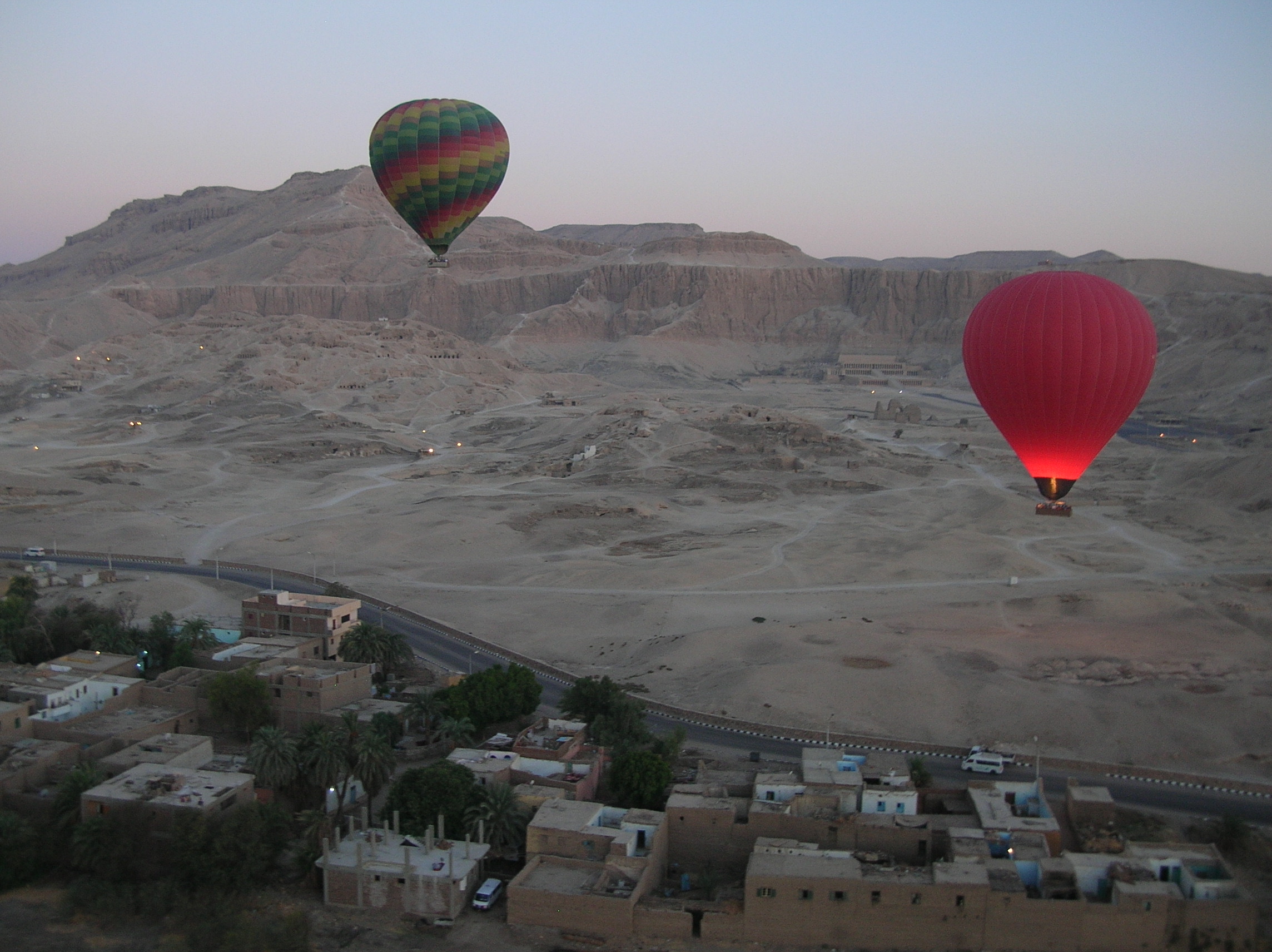
Journey to the Valley of the Kings by Hot Air Balloon

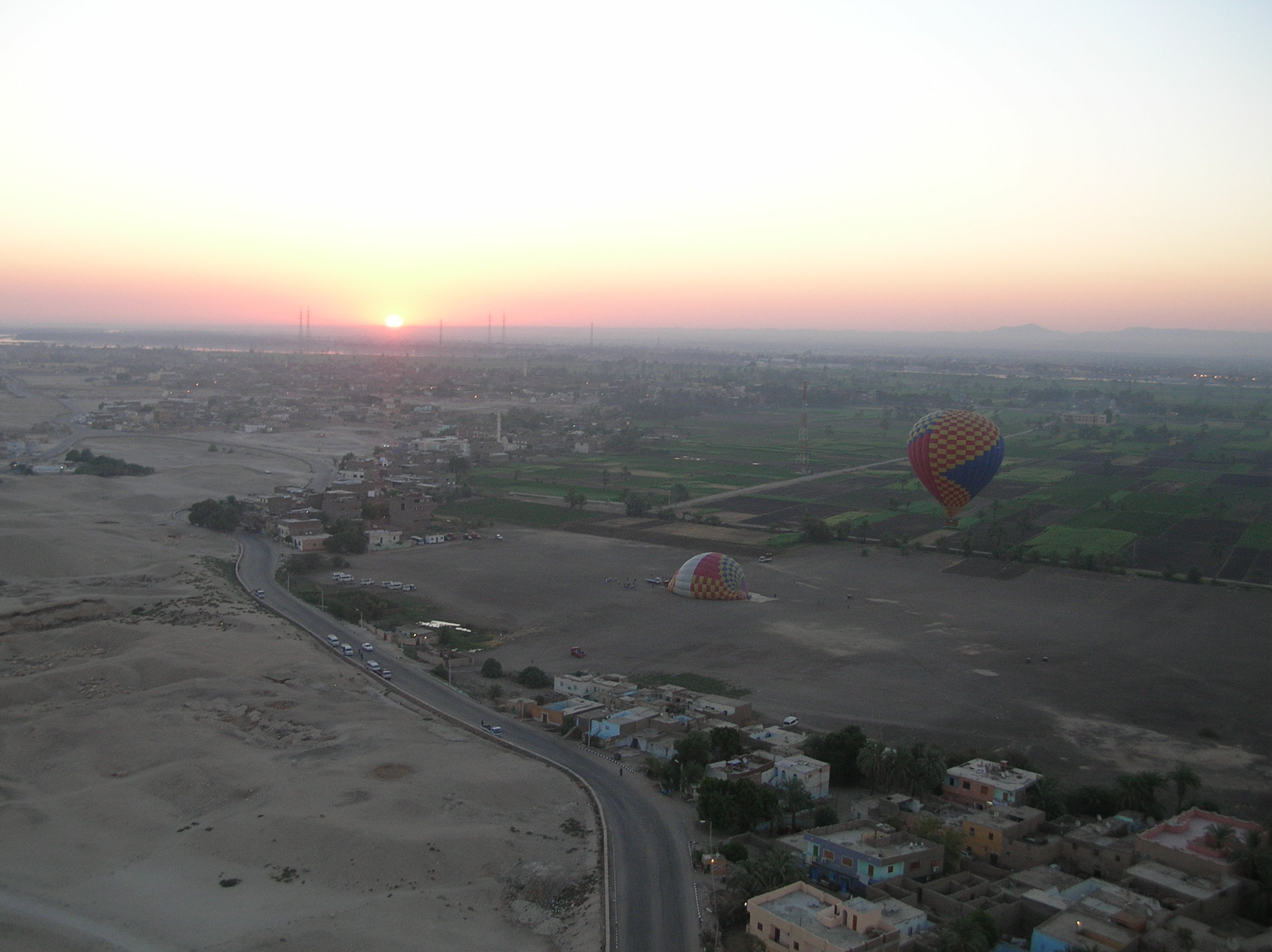
The most fantastic thing I did to research my novel To Chase the Glowing Hours was to fly near the Valley of the Kings in a hot air balloon. My sister, Jen, brother-in-law, Eric, and niece, Alice, toured Egypt together. The balloon ride was my twenty-two-year-old niece’s idea. I have a great fear of heights, but I didn’t want to miss out on a once-in-a-lifetime opportunity. 

Our group left the Luxor Palace Hotel in the early hours of the morning. While it was still dark, we rode a small ferry across the Nile and then took a van to the launch site. The balloons go up at sunrise because the winds are calmest, and the visibility is best. That morning, the tour company would send up about twenty balloons. The staff, young Egyptian men, lay the balloons flat on the ground. Then came the roaring of motors as the balloons inflated, followed by dramatic bursts of orange flames as each burner ignited. One by one, the balloons popped up and took shape.

As the first glow of pink appeared on the eastern horizon, I climbed into the balloon basket with my family and about ten others. The basket was four feet deep and divided into quadrants. The pilot stood in the middle, holding a cord that controlled the two burners to raise or lower the balloon. Terrified, I crouched. I gripped the rope handles inside the basket. The burners roared. I felt their heat. I expected the balloon launch to be something like an airplane lift-off. Instead, the balloon rose slowly, almost imperceptibly. If I hadn’t plucked up the courage to sit up and look out over the basket, I would not have known we were airborne. 

The striking view was that of the Nile and its banks, brilliant, green and winding, set against the stark brown desert. Rectangles of lush sugarcane fields, groups of houses, and thick brush ended in an abrupt demarcation. The desert, rugged and vast, appeared empty and utterly lifeless—just brown rocks and distant rocky hills. 

The balloon rose higher and gently drifted west toward the desert. In the east, beyond the Nile, a rim of purple and soft pink stood out against an azure sky. All at once, the sun rose like a silent explosion, a dazzling orb of orange red. This was the sacred moment of a newly born day. Time seemed to stand still, like Ra emerging in his solar boat, poised before sweeping across the sky. 

The sun illuminated the desert in a golden glow as the balloon drifted gently and peacefully. I still clenched a handle with one hand. I reminded myself to breathe. At the same time, the delight I felt at seeing the magnificent panorama of the golden desert surpassed my fear of heights. Aside from a few noisy, hot bursts of the burners, the ride felt tranquil. The other balloons in our cohort, drifting nearby, added to the colors and variety of the panorama. The air felt pleasantly cool.

The first ancient easily identifiable monument to come into view, and the most spectacular, was the Temple of Queen Hatshepsut. Built into the towering, fissured ridge behind it, the building unfolds into three massive terraces. I spotted the ramps of the terraces that I’d walked up a few days earlier.

As we neared the Valley of the Kings, I recognized the great peak of El Qurn among the sloping cliffs and a fleeting view of a road, zig-zagging upwards through them. I could see man-made alterations within the irregular shapes of the natural limestone rock formations. I’d experienced the enormous scale of the cliffs on foot that week. Seen from above, the sight of that mountainous cluster, wrinkled with canyons, came across as even more colossal and arresting. 

I couldn’t distinguish the Valleys of the Kings and Queens. Both seemed to be one rocky mass. Nor did I see any “valleys”—only crags. What I did see, due to a gift of the wind sending us in that direction, was Deir el-Medina, the ancient workers’ village. Situated within a natural amphitheater in the curve of cliffs, a walled enclosure contains stone foundations of about seventy dwellings. 

Soon, the views of the desert gave way to a patchwork of green fields, growing larger in our mostly sideways descent. It was time to land. The half hour in the air had passed quickly. I felt sorry the ride was ending. I heard a dog barking. To my delight, I saw a boy and a man with a dozen or so goats of varying colors, as well as a skinny brown dog. The curious boy looked upward, then ran toward a small house. Another man came out. The startled goats scattered.

A van from the balloon tour company approached on a small road between the fields. The van came to a stop near the field, and two staff members leapt out. The pilot threw ropes to them from our balloon. One of the goat herders shouted angrily at our pilot in Arabic. The pilot shouted back in Arabic. The pilot instructed us passengers to crouch for the landing. All I felt was a slight bump. Our group waited in the balloon basket while the burners cooled. The morning had turned very hot and sunny. 

The dispute continued. It related to the goat herder demanding payment for the balloon landing on his property. We’d drifted off course by a half mile. To me, that detour only added to the excitement of the tour. Soon, we climbed out of the basket and were ushered into the van, while the tour staff swiftly deflated and packed up the balloon. The goat herder received his payment. 

And so, my Egyptian hot air balloon adventure concluded, an hour of my life that I have relived with pleasure many times.

Check out the accompanying video to this blog post: https://youtube.com/shorts/G785MiTCVaw in the “To Chase the Glowing Hours: A Novel of Highclere and Egypt” playlist on the YouTube Channel Katherine Kirkpatrick @Sketches_and_Explorations.

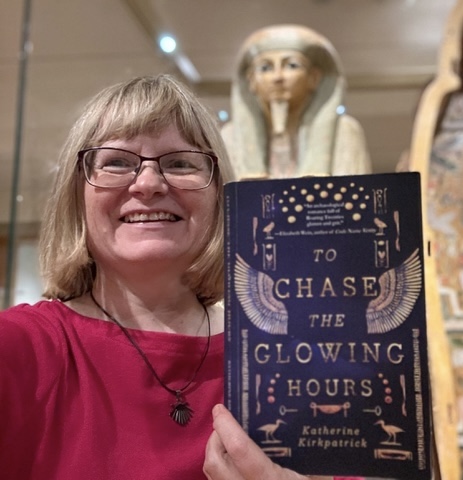
To Chase the Glowing Hours: A Novel of Highclere and Egypt by Katherine Kirkpatrick (Regal House Publishing, September 2025).

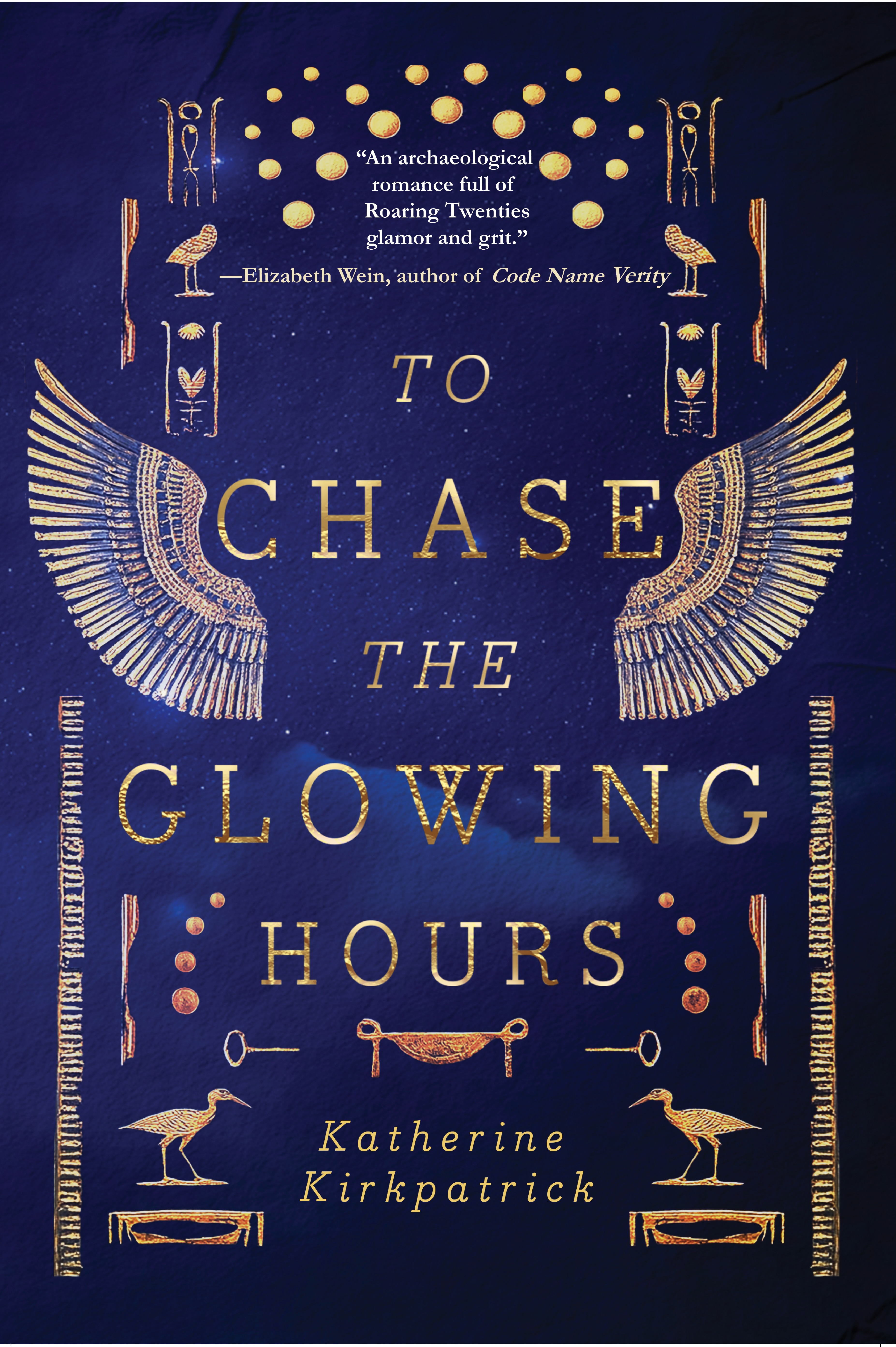
The Cover of My New Book

Dark blue was a favorite color in ancient Egypt. It is the color of the sky, home to the gods. Blue represents the cosmos and spirituality. It’s precious like lapis lazuli. I particularly like this color, so I am glad to see it featured on my new book cover.

Based on true-life characters and incidents, To Chase the Glowing Hours is a coming-of-age story about 21-year-old Lady Eve, who traveled in 1922 with her father, Lord Carnarvon, from her opulent home of Highclere Castle in the English countryside to the Valley of the Kings in Egypt. Her father’s hired archaeologist, Howard Carter, believed he’d found a royal tomb. A sealed doorway at the base of an underground stairway indicated that possibility. But of course, the phenomenal riches that Carter, Eve, and Carnarvon eventually uncovered would far surpass their expectations.

Gold was the color the ancients associated with royalty, divinity and immortality. King Tutankhamun’s tomb was filled with dazzling, golden objects, not least of them his solid gold sarcophagus. And since my novel To Chase the Glowing Hours (Regal House Publishing, September 2025) is about the Tutankhamun excavation, gold figures prominently on the cover. Gold also relates to the word “glowing” in the title.

The goddess Serket from Tutankhamun’s magnificent, gilded canopic shrine. Freepik.com

I wonder what Howard Carter would have thought of my book cover. As an exacting man who prided himself on his scholarship, he would have faulted its lack of accuracy. As attractive as the hieroglyphs are, they do not spell out an actual message. They are purely decorative.

Eve, however, would have enjoyed the cover. Her emotions and her senses guided her. Beholding Tutankhamun’s treasures as they emerged from the darkness was the greatest moment of Eve’s life. It wouldn’t have taken much to remind her of that experience—the warmth of a sunny day or the scent of perfume. The Egyptian theme of my book cover would have evoked a beautiful memory. 

For most people, enjoying ancient Egyptian culture is deeply connected to our senses. This is also true for me; however, reading books about Egyptian art has deepened my appreciation and understanding of it. Images that once puzzled me now resonate with clarity. Many Egyptian symbols relate to higher consciousness, immortality, eternity, and Oneness. These concepts are universal across various religions and hold personal significance for me.

Scarab design based on jewelry found in Tutankhamun’s tomb. Freepik.com

The pair of bird wings on the book cover resembles wings on scarabs. The scarab symbolizes rebirth. Wings lift the soul out of a discarnate body. The newly deceased pharaoh is often portrayed as a bird with a human head, as his soul is about to take flight. Deities are also depicted with wings; like birds, the gods and goddesses travel effortlessly throughout the cosmos. According to ancient Egyptian belief, we are soul travelers as well. There is a divine part in each of us that will ultimately express itself as starlight.

I hope you enjoy the deep blue and the elegant gold designs of the book cover. I especially hope you will enjoy reading To Chase the Glowing Hours. May the novel sweep you into the sensual world of King Tutankhamun’s treasures, ancient Egypt, and the worlds beyond.

The Art of Ink Painting

            Painting pictures is a nice change of pace for me. What I usually do is write very long books. My books involve a lot of research and require numerous rewrites. My forthcoming novel, To Chase the Glowing Hours (Regal House, Fall 2025), was in the making for twelve years before I received a contract to publish it. In contrast, I can usually create an ink painting in less than an hour. There’s a clear beginning, middle, and end to the process that feels very satisfying to me.

            I love the spontaneity of ink painting. I love the aesthetic of the art form. I love its simplicity. The goal of Chinese and Japanese ink painting is to capture the essence of something in a few bold strokes. You try to tap into the energy of your subject matter. You add only the details you want to be there.

“Red Crowned Crane” by Katherine Kirkpatrick.

            I’ve enjoyed making art ever since I was in high school, though I’ve let years lapse in which I did no drawing or painting. Twenty-three years ago, soon after my twins were born, I decided I wanted to learn Chinese ink painting. My family’s house has a view of a lake, and seeing the mist over that lake on cold winter mornings motivated me to paint the scene.

            I tried using regular watercolors on sturdy watercolor paper. To convey the mood of the mist and water, I diluted the paint. But I could not stop myself from outlining. My paintings looked tight and rigid. I remembered the softness of Chinese paintings on silk, the dark mountains emerging from clouds. How did those ancient Chinese artists create their atmospheric effects? My urge to learn their techniques was very strong.

            Through a Chinese community center, I found a teacher. His name was Long Gao and he taught out of his home. He’d been a professor of art in Beijing before moving to the U.S. His wife taught piano. Out of their many art and music students, most of them children, I was the only one who did not speak Chinese.

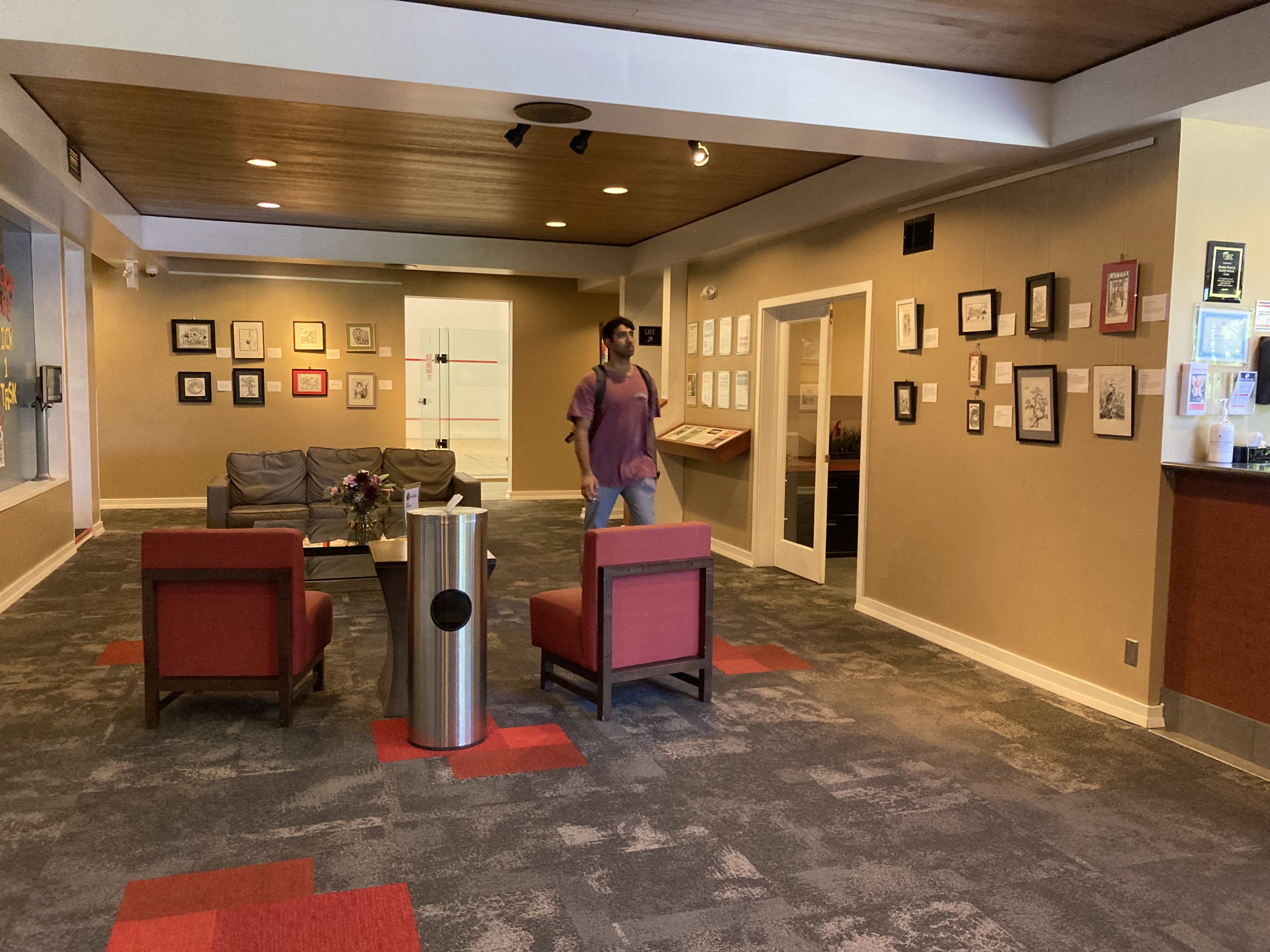
My art show in an athletic club.

            A stay-at-home mother, I had babysitting help twice a week for stretches of four hours. Once a week for several years, I had a private lesson from Long Gao. He is a phenomenal artist and a wonderful teacher. Ink painting is only one of his many mediums. He is well known as an oil painter and as a sculptor.

            Teacher Gao sold me a large sheep-hair brush, and two other brushes that were a combination of horse-hair, wolf-hair, and badger-hair. He showed me how to soak my brushes in water, and how to flex them so they’d slowly absorb the black ink. I learned that if I could load the ink on my brush in a certain way, each stroke I made on the rice paper presented several tonal values.

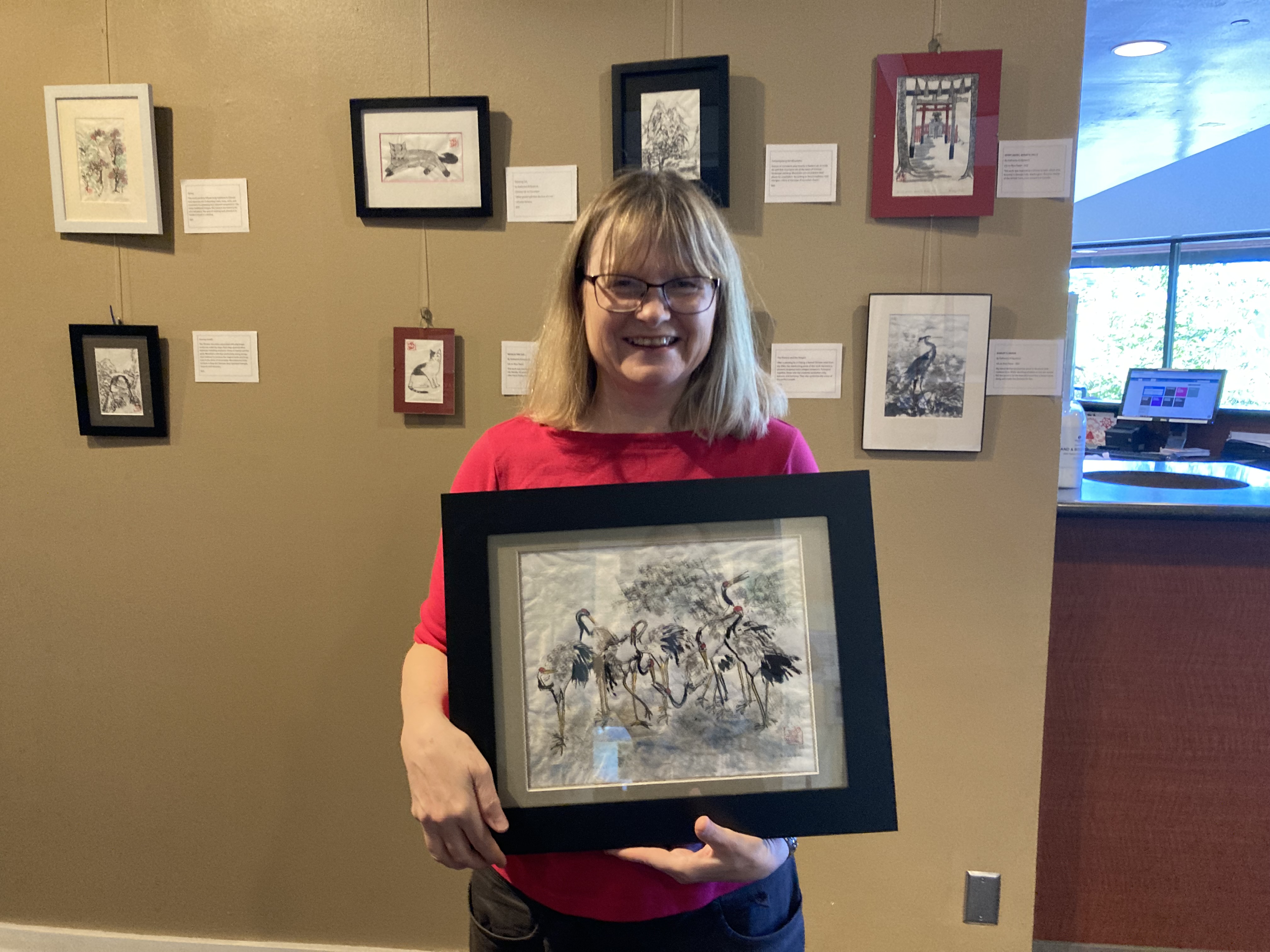
At my art show in the athletic club, holding a painting of cranes, “The Social Hour.”

            One of the first subjects I learned to paint was bamboo. We began with the stalk. “Paint in the direction that the bamboo is growing,” Teacher Gao said. He showed me how to push the brush forward, pausing between segments. “Paint with the energy of the heart going out through your arm, into your hand, and into the brush,” he taught me. Over time, I realized I was learning a spiritual practice akin to meditation, and that it was very important to paint from a state of inner quiet.

            One week, Teacher Gao placed a three-sided rock on his art table to serve as inspiration for painting mountains. Numerous mountains could be painted without dipping the brush into more ink. When the brush became drier, its ink came out lighter on the page. The lighter ink worked well for painting the suggestion of distant peaks. To create clouds or mist, I simply needed to leave white space between the forms of my mountains and peaks. This was the answer to the question that had started me on my journey of ink painting.

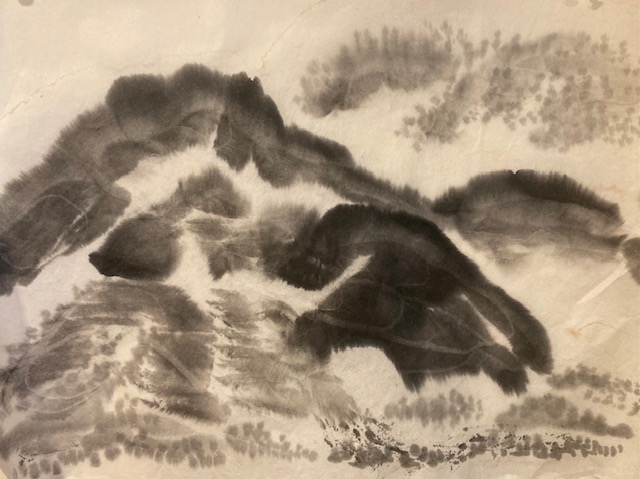
One of my first ink paintings.

            Teacher Gao carved my beautiful chops (printing stamps). He created an image of twin birds in honor of me being the mother of twins. The other image, designed with Archaic Chinese characters, is a Buddhist name I was given many years ago by a Soto Zen master in New York: Ro-ki (Japanese) or Ro-chi (Chinese), meaning “bright life force.”

            I was very lucky to have studied traditional ink painting with Teacher Gao, and I think of him every time I “sign” my paintings in red with the chops that he made.

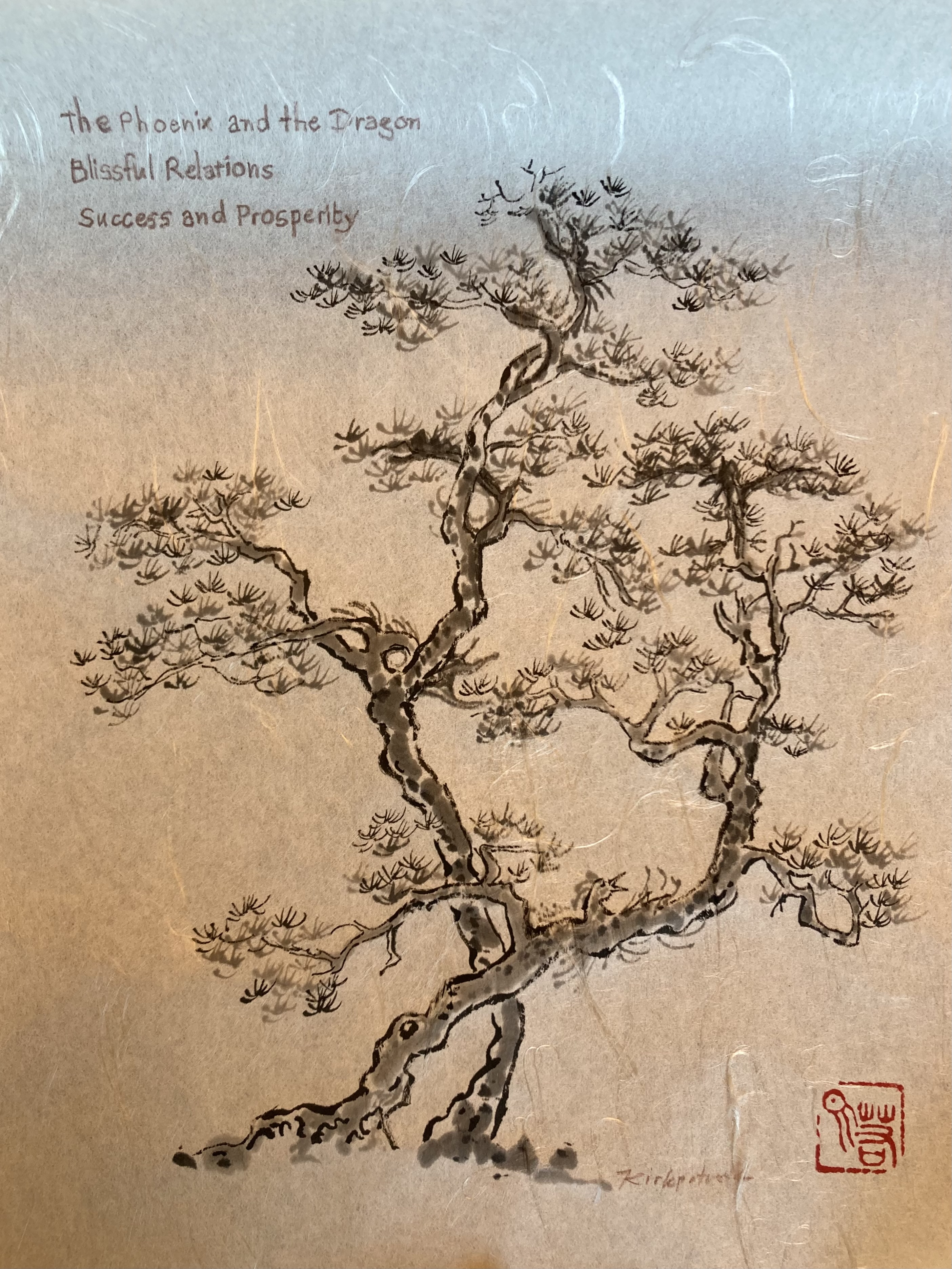
“The Phoenix and the Dragon” by Katherine Kirkpatrick after Li Cheng (919-967 A.D.)